

WiredScore SmartScore
Buildings that keep up with their users

Technology moves faster than buildings do. Connectivity and smart systems are now the first thing occupiers ask about and the first thing to date an asset. Certify with WiredScore or SmartScore to prove your building's digital infrastructure is resilient, well-designed and ready for what comes next - and to say so with independent, globally recognised evidence.
What’s the Difference? WiredScore vs SmartScore
Focus Areas
WiredScore is about connectivity. It assesses how reliably a building gets data in and out and how well that infrastructure is designed to last - carrier diversity and resilience, entry points and riser routes, mobile signal, public and amenity Wi-Fi, protection of critical equipment, and capacity for future upgrade. It is the right starting point for almost any asset, because nothing smart works without it.
SmartScore, by contrast, assesses what the building actually does with its technology. It evaluates whether systems talk to each other, whether data is structured, owned and shared properly, whether cybersecurity is governed rather than assumed, and whether all of that translates into real functionality for the people using the building. Connectivity is a prerequisite, so most clients pursue SmartScore alongside or after WiredScore.
Use Cases
WiredScore suits offices, residential, industrial and hotel assets at almost any stage - new developments specifying infrastructure from scratch, and occupied buildings looking to benchmark, improve and market what they already have.
SmartScore suits flagship developments, major refurbishments and ESG-led portfolios where significant investment is going into building systems and the client needs a framework to direct it - and independent proof that it worked.
Scoring Approach
Both certifications are scored out of 100 points across two pillars: User Functionalities, covering what building users actually experience, and Technological Foundations, covering the infrastructure, integration and governance underneath.
WiredScore weights those pillars differently by asset stage. For occupied buildings the split is 50/50 - the building is in use, so delivered performance and underlying infrastructure carry equal weight. For buildings in development the split is 65/35 toward User Functionalities, reflecting what the design commits to deliver.
Unlike some frameworks, certification levels carry minimum requirements as well as point thresholds. A building can't buy its way to Platinum on volume of credits alone - it has to clear the fundamentals first.
Certification Structure
For occupied buildings, certification lasts two years. For buildings in development, certification runs until 18 months after substantial completion, at which point the asset moves onto the occupied standard.
Developments can also achieve pre-certification shortly after kick-off, which lets you market the commitment while the scheme is still being built. Assessment is desktop-based - evidence, drawings and specifications rather than site visits - so it works comfortably for international portfolios and distributed design teams.
What is WiredScore?
WiredScore is the global standard for digital connectivity in buildings. It assesses the infrastructure that everything else in a modern building now depends on - internet service provision, in-building mobile coverage, digital services, riser and pathway design, resilience against outage and cyber risk, and the headroom to adopt whatever technology arrives next.
Launched in New York in 2013 with the backing of the Mayor's office and brought to the UK in 2015, WiredScore has since certified over 4,000 buildings and more than a billion square feet worldwide. It gives landlords, developers and design teams a structured way to specify connectivity properly at design stage, to find and fix weaknesses in an existing asset, and to evidence the result to occupiers, agents and investors.
What about SmartScore?
Its counterpart, SmartScore, assesses the building as a whole technology ecosystem - not just the pipes, but what runs through them. It looks at the outcomes a smart building delivers for its users (access and navigation, wellbeing, sustainability technology, digital services, safety and security, operational excellence) and the foundations that make those outcomes possible (systems integration, cybersecurity, data management).
Whether you're certifying an occupied asset or specifying a development still on the drawing board, Welscape can help you set a realistic target, assemble the evidence, and get the certification over the line without derailing your programme.
Benefits of WiredScore
Faster Leasing and Stronger Occupier Retention
Connectivity is now a leasing question, not a facilities question. Occupiers ask about it early, and the answers are usually vague until someone has certified. A WiredScore rating gives leasing teams a credible, third-party answer plus a building fact sheet agents can hand over on a tour - no technical translation required. Certification has been used specifically to differentiate assets in competitive markets and secure anchor tenants ahead of completion, as Trammell Crow Company did in reaching WiredScore Platinum at the Welcome Building in Bristol.
Design Validation for Developers and Design Teams
On a development, the most expensive connectivity mistakes are the ones you can't undo - riser sizing, entry point diversity, plant room location, containment routes. WiredScore front-loads those decisions and tests the design against a global benchmark before anything is poured. You get a certification report assessing your technical design, a best practice guide, and a defined target to design toward rather than a vague ambition to "make it smart".
Fewer Disruptions and a Better Experience for Occupiers
Internet downtime costs an estimated $300,000 per hour, and around 70% of internet issues trace back to in-building infrastructure rather than the provider. Certification pushes buildings toward carrier choice, diverse routing, protected equipment and proper mobile coverage - which occupiers experience simply as things working. Where SmartScore is in play, the gains extend to environmental data, comfort control, frictionless access and better-run buildings.
Investor Confidence and ESG+R Alignment
Technology obsolescence is a real depreciation risk, and investors have started asking about it. Certification gives you a defensible position: an independent assessment, benchmark data against comparable assets regionally and globally, and an investor report tailored to that audience. WiredScore and SmartScore both align with GRESB and PRI reporting, and assess 100% of a building's floor area - which matters for how those points are credited.

How WiredScore Works:
The Certification Process
At Welscape, I deliver WiredScore and SmartScore certifications through a structured, six-stage process that's evidence-based, fully remote, and designed to work for occupied assets and developments alike.
Rigorous, Benchmarked, and Globally Consistent
WiredScore and SmartScore use criteria-based scoring applied consistently worldwide, so a Platinum in London means the same thing as a Platinum in Sydney. That consistency is the point - it's what makes the rating useful to an international investor or a global occupier comparing assets across markets.
Assessment is mainly desktop-based with a single site visit required to validate installations; otherwise certification is evidenced through drawings, specifications, service provider agreements, test results and policy documents. Where an occupied building falls short, the certification report tells you precisely which criteria are unmet and what would close the gap.
WiredScore Scoring Breakdown
Each building is scored out of 100 points across two pillars and six categories:
User Functionalities - what the building delivers to its users:
Internet Service Provision: choice of provider, service diversity, resilience, and the ability to support bandwidth-intensive and cloud-based working.
Mobile Performance: in-building mobile coverage across carriers, and the infrastructure to improve it.
Digital Services: public and amenity Wi-Fi, digital platforms, and services that improve the occupier experience.
Technological Foundations - what sits underneath:
Infrastructure Setup: entry points, risers, pathways, telecom rooms and containment designed for capacity and flexibility.
Technology Resiliency: protection of critical infrastructure against outage, flood, physical damage and cyber risk.
Future Readiness: spare capacity, adaptability, and the ability to adopt new technology without rework.
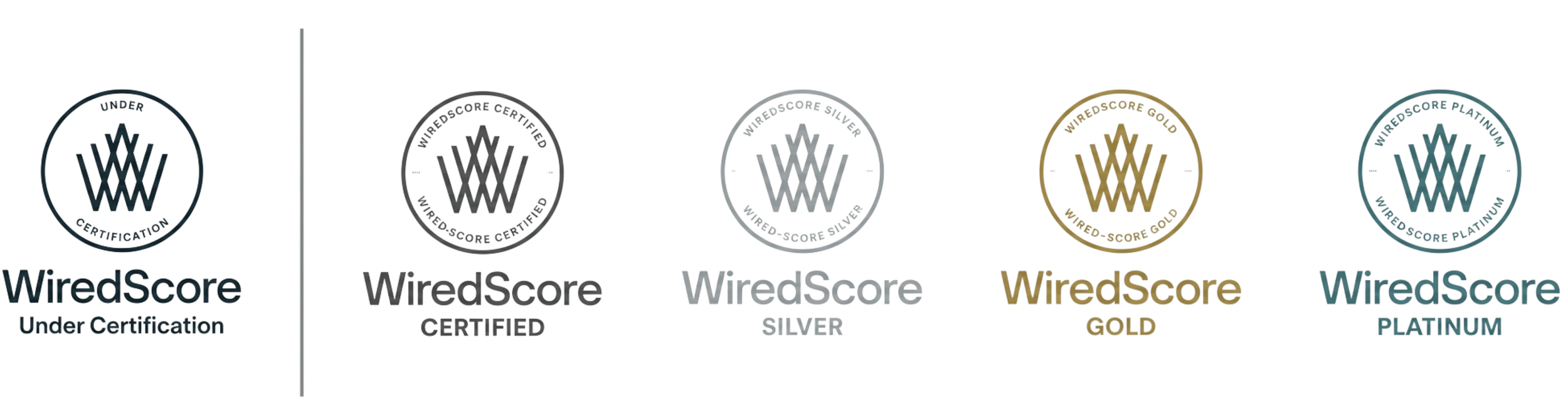
Certification levels are awarded on total score combined with minimum requirements at each level:
Key strategies to consider:
✔ Carrier Diversity & Redundancy - Secure multiple internet service providers with genuinely diverse physical routes and entry points, so a single street works can't take the building offline.
✔ Protected Entry Points & Telecom Rooms - Locate and protect points of entry, risers and comms rooms against flood, heat and unauthorised access, with backup power for critical equipment.
✔ In-Building Mobile Coverage - Test coverage properly across all major carriers and provide the infrastructure - DAS, small cells or passive provision - to fix the dead spots rather than hoping nobody notices.
✔ Riser & Pathway Capacity - Size containment, risers and pathways for growth and for competing providers, and document routes so future works don't turn into archaeology.
✔ Building Systems Integration - Bring BMS, access control, lighting, metering and lift systems onto a coherent, connected network rather than a set of isolated proprietary silos.
✔ Cybersecurity Governance - Put a documented cybersecurity policy, network segregation, assessment schedule and data privacy policy in place - and evidence that they're actually implemented.
✔ Data Ownership & Structure - Define who owns building data, how it's structured and tagged, and how occupiers can access what's relevant to them. This is where most SmartScore submissions win or lose points.
✔ Occupier-Facing Digital Services - Deliver a building app or platform covering access, wayfinding, bookings, environmental data and service requests, so the technology is visible to the people it's for.
The Process, step-by-step
Step 1: Kick-Off and Scoping
We start with a kick-off call, typically within two weeks of engagement, to scope the asset, confirm which certification and scorecard applies, and agree an execution plan that fits your programme. For developments, this happens early enough to influence design; for occupied buildings, it establishes what evidence already exists.
Step 2: Target Score and Gap Analysis
We assess the building or design against the relevant scorecard and set a realistic target level. You get a clear view of where you currently sit, which credits are within reach, and what each one would take. For developments, this is also the point at which pre-certification can be awarded, letting you market the commitment while construction is underway.
Step 3: Evidence Gathering and Improvement
We collect and prepare the evidence - drawings, specifications, service provider agreements, coverage test results, policies and system documentation - and work through the improvements worth making. WiredScore allows multiple evidence set reviews, so the submission is refined rather than gambled on a single shot. Where changes are needed, we advise on what's proportionate and what isn't.
Step 4: Certification, Promotion and Renewal
Once the evidence is accepted, the certification and score are issued along with your full toolkit: certification seals, building fact sheet, marketing toolkit, best practice guide, benchmark reporting and Insights Hub access, plus a listing on the WiredScore map of certified buildings. Occupied certifications run for two years; development certifications run until 18 months after substantial completion, when the asset transitions to the occupied standard.
Services
Specialist capacity, without the headcount
Consultancy, contractor or in-house team with more certification work than people to deliver it? I plug in for as long as the work exists across commercial fit-outs and refurbishments. You keep the client. I handle the assessment.





Get in touch
george@welscape.co.uk
+447542341750

George Michael Kakas
Owner at Welscape
WiredScore | SmartScore FAQs
-
WiredScore certifies offices, residential buildings, industrial assets and hotels, and both standards extend to portfolios and neighbourhood-scale masterplans. SmartScore is currently focused on office assets, where the density of building systems makes it most applicable. Certification works for buildings in development and buildings already in use — the scorecard simply changes to reflect the stage.
Interested in certifying your asset or portfolio? Contact us to find out which standard fits.
-
The process is mostly remotely and desktop-based with one site visit required. Timescales depend on how complete your evidence is at the outset. For an occupied building with documentation to hand, expect a matter of weeks; for a development, certification typically tracks the design programme and is finalised around detailed design.
Want a realistic timeline for your project? Reach out today and we'll scope it against your programme.
-
WiredScore assesses digital connectivity — internet provision, mobile coverage, digital services, infrastructure design, resilience and future capacity. SmartScore assesses the wider smart building ecosystem: systems integration, cybersecurity, data management, and the functionality all of that delivers to users. Connectivity underpins everything smart, so WiredScore is usually the logical first step, with SmartScore following or running alongside.
Not sure which is right for your project? Message us and we'll compare them against your asset.
-
Both certifications are scored out of 100 points across two pillars: User Functionalities and Technological Foundations. WiredScore weights these 50/50 for occupied buildings and 65/35 for buildings in development. Certification levels — Certified, Silver, Gold and Platinum — are awarded on total score together with minimum requirements at each level.
Curious how your building would score? Let's take a look and map out a realistic target.
-
Yes. Unlike some point-only frameworks, WiredScore and SmartScore apply minimum requirements at each certification level alongside the score. That means a building can't reach Platinum by accumulating easy credits while leaving a fundamental weakness unaddressed. In practice this is a strength — the rating means something to the occupiers and investors reading it.
Want to know which requirements you'd currently miss? Get in touch for a gap analysis.
-
Occupied certifications last two years. Development certifications remain valid until 18 months after substantial completion, at which point the building recertifies against the occupied standard. The shorter cycle is deliberate — technology moves quickly, and a five-year-old connectivity rating tells an occupier very little.
Planning a phased upgrade or a recertification?Book a chat to sequence it properly.
-
Existing buildings certify routinely, and often score better than their owners expect. Much of what WiredScore rewards — provider choice, riser capacity, protected plant, mobile coverage — is already present but undocumented. Where there are genuine gaps, the certification report identifies them precisely, which makes the business case for improvement far easier to write than a vague sense that "the wi-fi is bad".
Operating an older asset? Let us show you where it stands before you commit to anything.
-
WiredScore and SmartScore certify buildings, not individual tenancies — the assessment sits with the landlord or developer and covers the base build and shared infrastructure. If you're an occupier, certification is still highly relevant: a certified building gives you documented answers on connectivity resilience and mobile coverage before you sign, and I can help interpret a building's rating and fact sheet as part of your due diligence.
Assessing a building before you commit to a lease? We can help you read it properly.
-
For developers and landlords, certification supports faster leasing, design validation, and a defensible position on technology obsolescence. Assets have used WiredScore Platinum specifically to differentiate in competitive markets and secure early anchor leases. For occupiers, a certified building means fewer outages, better mobile coverage, real provider choice, and far less time lost to infrastructure that doesn't work — against a backdrop where internet downtime is estimated to cost $300,000 per hour.
Looking to differentiate your asset in a tight leasing market? We can help you position it.
-
Yes. Both align with GRESB and PRI, and support the Resilience dimension of ESG+R by addressing infrastructure redundancy, cyber risk and climate protection of critical plant. They also feed environmental reporting — you can't measure and optimise energy, water or air quality without the connectivity and data infrastructure to do it. Notably, both standards assess 100% of a building's floor area, which affects how credits are counted in a GRESB submission.
Want to strengthen your GRESB score? Get in touch to see how certification contributes.