

BREEAM AP
Expert support, design and site

BREEAM is the most established sustainability assessment method in UK construction, and the one most likely to appear in a client brief without much explanation of what it will actually take to achieve.
I'm a certified BREEAM Advisory Professional with seven years supporting assessments across commercial fit-out and refurbishment. I work as a subcontractor to contractors, consultancies and design teams who need the BREEAM workload handled properly without adding a permanent head.

What is BREEAM?
BREEAM (Building Research Establishment Environmental Assessment Method) was launched by BRE in 1990 and was the world's first sustainability assessment method for buildings. It remains the most widely specified scheme in UK commercial property.
Buildings are assessed across a set of weighted environmental categories, scored against defined criteria, and awarded a rating. Each rating level carries minimum standards as well as a score threshold, so a project can't reach Excellent by collecting easy credits while leaving a fundamental requirement unmet.
The categories
Management - procurement, commissioning, handover and stakeholder engagement
Health & Wellbeing - daylight, air quality, acoustics, thermal comfort, accessibility
Energy - demand reduction, metering, efficient systems, low-carbon technology
Transport - public transport access, cycle provision, travel planning
Water - consumption, monitoring, leak detection
Materials - responsible sourcing, life cycle impacts, durability
Waste - construction waste management, recycled aggregates, adaptability
Land Use & Ecology - site selection, ecological value, long-term management
Pollution - refrigerants, NOx, surface water run-off, light and noise
Innovation - exemplary performance and approved innovation credits
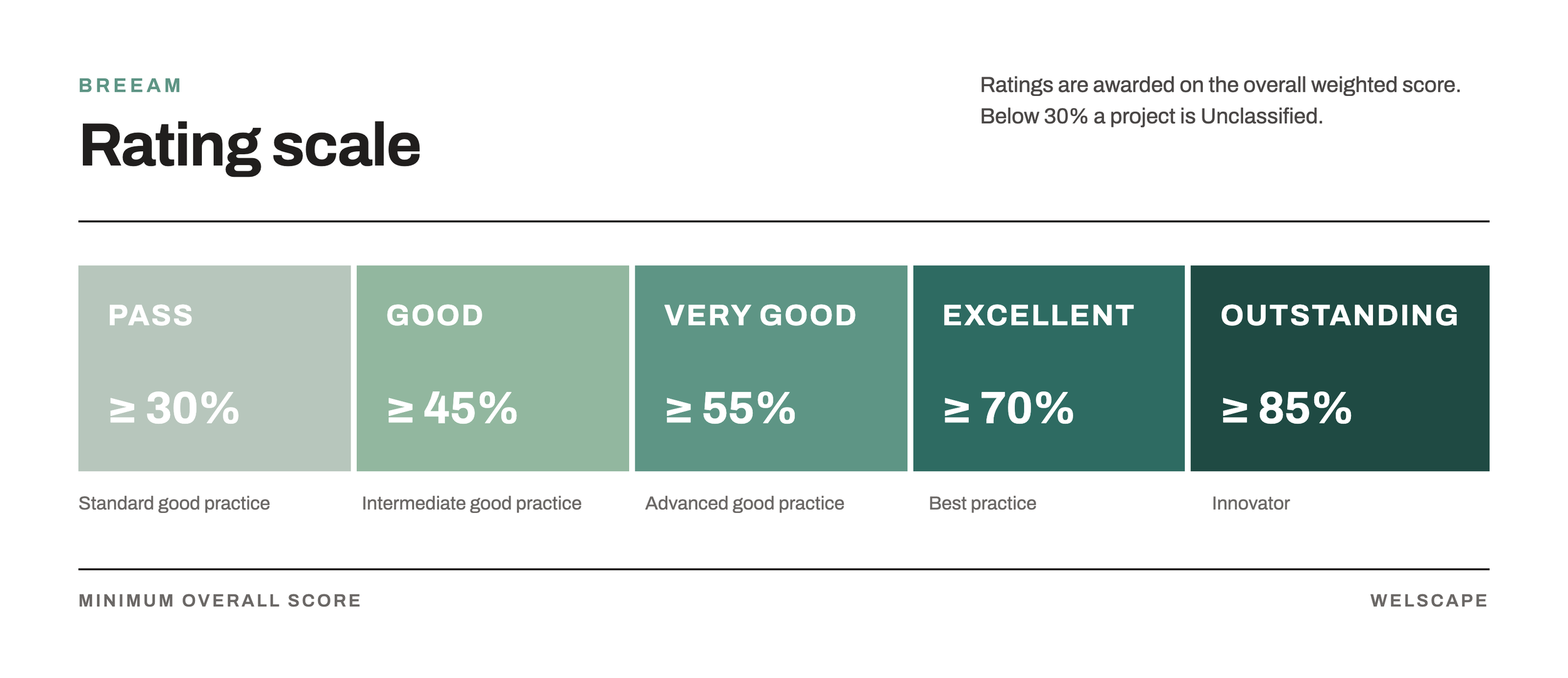
Which scheme applies to a fit-out?
BREEAM Refurbishment and Fit-Out (RFO) is the scheme most commercial interiors projects sit under. It's structured in parts covering fabric and structure, core services, local services and interior fit-out, so the assessment scope flexes to match what the project is actually touching.
Most Cat A and Cat B office projects assess against the parts relevant to their scope rather than the whole building - which is exactly why scoping the assessment correctly at the outset matters so much.

THE ROLE
What a BREEAM AP actually does
A BREEAM Advisory Professional is an accredited specialist who guides a project team through BREEAM - setting targets, chairing the workshops, resolving trade-offs between credits, and making sure the sustainability requirements are embedded in the design rather than bolted on afterwards.
The role exists because BREEAM outcomes are decided by design decisions, not by paperwork. By the time an assessor is collating evidence, the achievable rating has already largely been fixed.
WHERE I ADD THE MOST VALUE
Early target setting - an honest read on what rating is achievable for the budget and the scope, before it goes in a brief
Pre-assessment and gap analysis - where the project currently sits and what each remaining credit would cost to secure
Design team facilitation - running the workshops, chasing the actions, keeping BREEAM on the agenda between stages
Trade-off decisions - which credits to chase, which to release, and when to stop spending money on a rating you've already secured
Evidence strategy - deciding at design stage who produces what, so nobody is reconstructing a paper trail during handover
Site stage support - inspections, contractor liaison, and picking up the credits that get lost on site
Worth knowing: appointing a BREEAM AP is itself credit-earning. The Management category rewards the early appointment of a sustainability champion and their continued involvement through the project, subject to the criteria in the scheme version applying to your project.
In other words, the appointment can pay for part of itself before any other work is done.
Services
Specialist capacity, without the headcount
Consultancy, contractor or in-house team with more certification work than people to deliver it? I plug in for as long as the work exists across commercial fit-outs and refurbishments. You keep the client. I handle the assessment.





Got a BREEAM Project that needs a pair of hands?
george@welscape.co.uk
+447542341750

George Kakas
Owner at Welscape
BREEAM FAQs
-
No - and neither can any BREEAM AP. Certification requires a licensed BREEAM Assessor, who formally assesses the evidence and submits to BRE. What I do is everything that surrounds that: target setting, design team facilitation, credit strategy, evidence collation, write-ups and submission management.
On most of my projects there's an assessor appointed and I work alongside them. It usually makes the assessment faster and considerably less painful for everyone.
Not sure what your project needs? Ask me.
-
A BREEAM Advisory Professional has completed BRE's training and examination and is accredited to advise project teams through the BREEAM process. The role covers target setting, facilitating the design team, driving credits and embedding sustainability requirements into the project properly.
I hold both design stage and site stage accreditation, which means I can support a project from concept through to handover rather than only one end of it.
-
Yes. The Management category rewards the early appointment of a sustainability champion and their continued involvement through the project stages. The exact wording and credit availability depends on the scheme version applying to your project, so it's worth confirming against your specific scorecard.
The practical point is that appointing early is both cheaper and worth more than appointing late.
Want to check what's available on your scorecard? Get in touch.
-
Most commercial interiors projects sit under BREEAM Refurbishment and Fit-Out (RFO). It's structured in parts covering fabric and structure, core services, local services and interior fit-out, so the scope of assessment can be matched to the scope of works.
Which parts apply is one of the most consequential early decisions on a BREEAM fit-out, and one that's frequently got wrong. If you're unsure, it's worth a conversation before anything is committed.
-
If that's what the project needs, yes. I work in your systems, to your templates and within your reporting lines. You keep the client relationship throughout and your project lead still leads.
Often the client doesn't know I'm not one of your team, and that suits me fine.
-
Depends on the engagement. A fixed fee works well for a defined scope on a single project. Day rate or retained capacity tends to suit teams with recurring workload or a framework agreement.
Either way you'll get a clear scope and a fee before anything starts, and I'll tell you if I think the work doesn't need me.
Send me the scope and I'll come back with a figure.
-
Regularly. Plenty of fit-outs run BREEAM alongside SKA, Fitwel or ActiveScore, and there's meaningful overlap in the transport, health and wellbeing and materials evidence.
Running them together with one person coordinating means the evidence does double duty rather than being gathered twice. Worth flagging at the outset if more than one scheme is in play.